

24×7 – 365 Days | [email protected] |
24×7 – 365 Days | [email protected] |
24×7 – 365 Days | [email protected] |
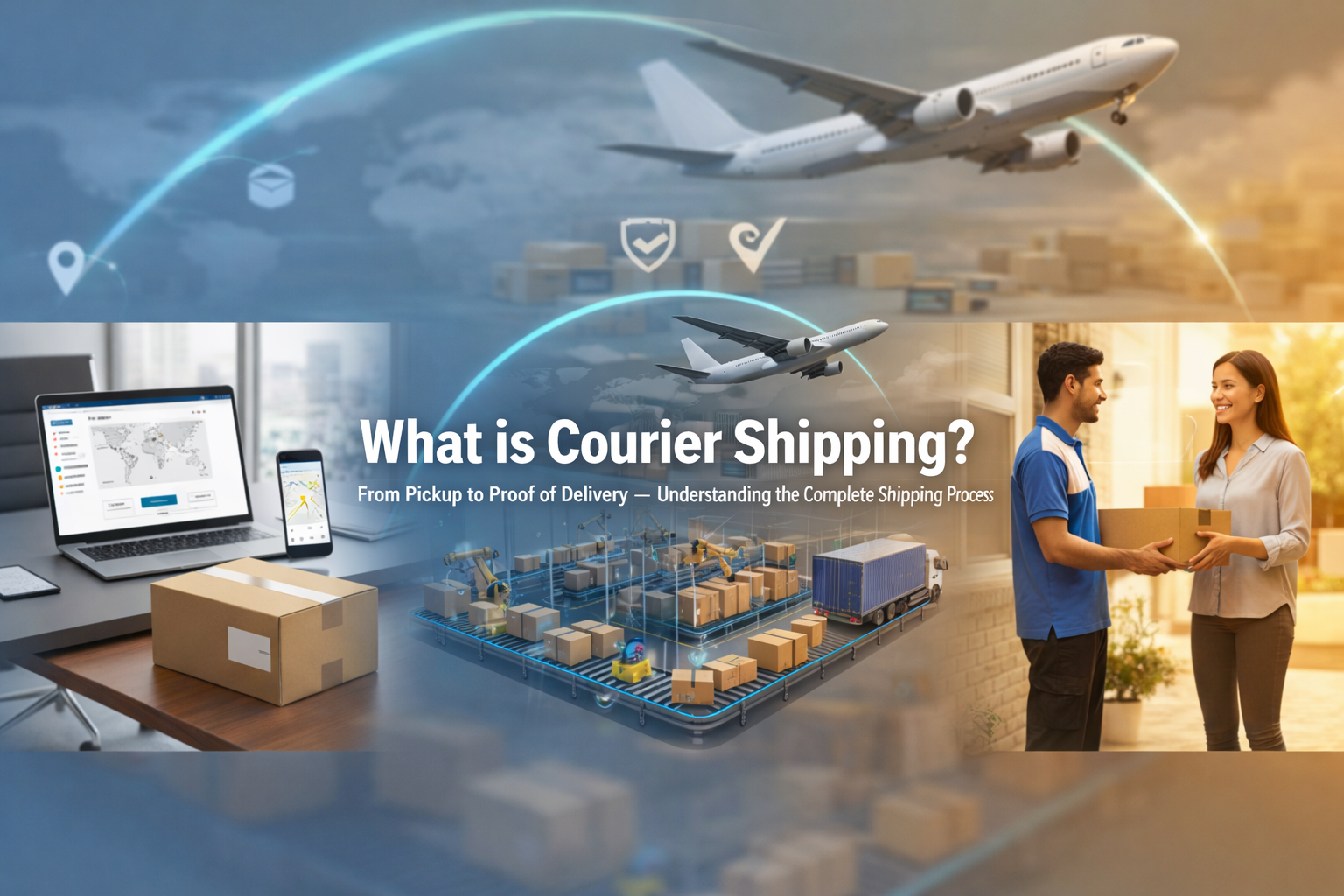
Courier shipping is a professional, door-to-door parcel delivery service that picks up a shipment from the sender’s address and delivers it directly to the recipient within a defined timeframe — with real-time tracking and proof of delivery at every stage. It is used for both domestic and international shipments where speed, reliability, and accountability matter.
When someone needs to send a document or bags to another country, they do not use regular post. They use a courier. Unlike postal services that move packages in bulk with limited visibility, courier companies operate on time-committed logistics networks where every parcel is individually scanned, tracked, and delivered with digital confirmation of receipt.
This guide is for everyone, a first-time sender, NRI, e-commerce seller, student, or business shipper needs to know — from what courier shipping actually means, to how charges are calculated, what can and cannot be sent, and how to avoid the most common problems.
Courier shipping means sending a package through a private company that collects the shipment from your home or office and delivers it directly to the recipient, while monitoring its exact location at every stage of the journey. The sender does not need to visit a post office or drop-off point. The logistics network comes to the sender.
From the moment the booking is confirmed, the parcel enters a controlled and accountable chain: it is collected, scanned, sorted, transported, and delivered — each step recorded digitally. This end-to-end accountability is what makes courier shipping fundamentally different from dropping a letter in a postbox.
Shipment Chain: Booking → Pickup → Origin Sorting Hub → Linehaul Transport → Destination Hub → Last-Mile Delivery → Proof of Delivery
The word ‘courier’ has centuries of history behind it. Historically, a courier was a trusted messenger appointed by rulers, governments, or institutions to hand-deliver confidential documents or valuable items. The three defining qualities that made a courier different from any other messenger were:
Modern courier companies have replicated this same promise at a global scale using vehicles, aircraft cargo capacity, automated sorting hubs, and digital tracking platforms. The technology has transformed completely. The commitment has not. When you book a courier shipment today, you are engaging a professional accountable messenger — one that has scaled from a single trusted individual to a network of thousands of agents, hubs, and transport routes.
Courier services and postal services both move packages from one address to another — but the structural, operational, and accountability differences are significant. Here is how they compare across the dimensions that matter most to senders:
Feature | Courier Service | Postal Service |
Delivery Speed | Time-defined: same-day to 7 days | Route-based: 5–30+ days |
Tracking | Live multi-point scanning at every hub & vehicle | Limited — origin & destination only |
Pickup | Doorstep collection from the sender’s address | The sender must visit the post office |
Reliability | High — SLA-backed delivery commitments | Moderate — no guaranteed delivery date |
Parcel Handling | Individual scanning on conveyor belts | Bulk sorted in bags & trays |
Proof of Delivery | Digital signature or OTP recorded at delivery | Rarely captured |
Cost | Higher — reflects speed & accountability | Lower — suited to non-urgent mail |
Best Use Case | Important, urgent, or high-value shipments | General letters & low-priority parcels |
The right choice depends on what you are sending. For birthday cards or something like i phone, postal mail is perfectly adequate. For anything where timing, traceability, or proof of receipt matters, courier shipping is the professional standard.
Courier networks are engineered for situations where reliability matters more than the lowest possible cost. Understanding which shipments genuinely require courier handling — and why — protects your interests every time you ship.
These are shipments that lose their entire purpose if they arrive even one day late. Common examples include passport submissions for visa appointments, university admission documents, tender bid papers, legal contracts with filing deadlines, and medical reports needed before a procedure. Courier services are the correct choice because they operate on published Service Level Agreements (SLAs) — a next-day service guarantees delivery by a specific time, and real-time tracking gives both sender and recipient full visibility at every point.
Electronics, original certificates, branded merchandise, business product samples, jewellery, and luxury goods all fall into this category. Courier systems provide traceable accountability at every physical handoff point — meaning if a parcel goes missing, the last barcode scan identifies exactly where in the network it disappeared. Most courier companies offer shipment value protection or cargo insurance, providing financial coverage up to a declared value in the event of confirmed loss or damage.
Glass items, festival gifts, electronic components, laboratory samples, and fine-art prints require individual physical protection throughout transit — not just good packaging at origin. Courier sorting facilities use individual barcode-guided conveyor belt systems where each parcel moves independently through the sorting process. This is fundamentally different from postal systems, where bulk mail is sorted in sacks, meaning items are grouped and compressed together. For fragile shipments, individual handling is a baseline operational requirement — and courier networks provide it as standard.
Most senders assume a courier parcel travels directly from their address to the recipient’s city, like a taxi from A to B. In reality, courier shipping operates more like a commercial airline flight: your parcel travels through multiple structured processing points, each with a defined role in the journey.
Understanding this process explains why tracking shows multiple location updates, why booking time determines same-day pickup availability, why delays occur at specific stages, and why correct documentation is critical for international shipments.
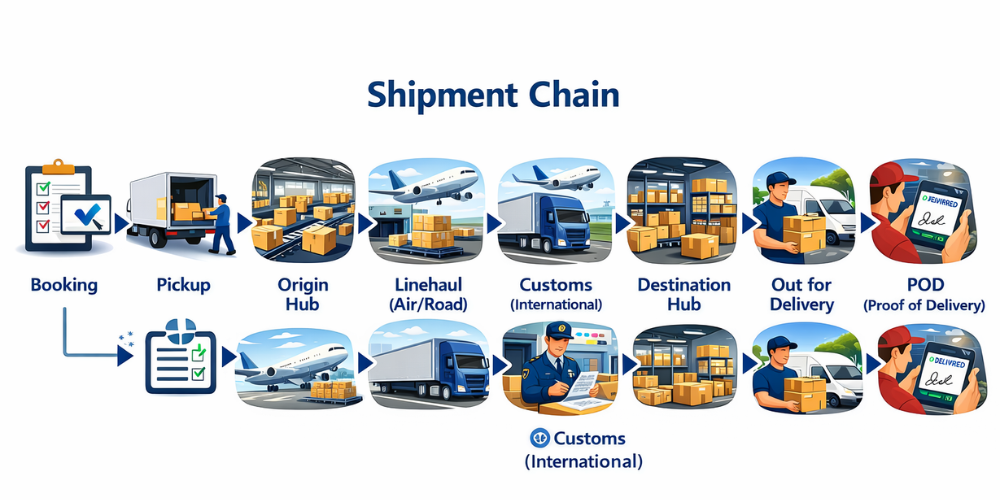
The shipment journey begins digitally — before any physical movement. When a sender books online, they provide the information that allows the courier’s system to pre-plan the entire route before the agent arrives.
Information Required at Booking
This information does more than calculate a price — it pre-assigns the parcel to a specific routing path through the hub network. The system selects which origin hub the parcel will be sent to, which linehaul route it will travel, and which destination hub it will arrive at — all before physical collection.
Pickup Scheduling
Once confirmed, the booking is assigned to a delivery executive whose route already covers the sender’s area that day. This is why same-day pickup has a cut-off time — typically mid-morning. Bookings placed after the cut-off are scheduled for the following business day. The system appends the pickup to an existing optimised route — it does not dispatch a dedicated vehicle for a single booking.
When the courier agent arrives, they are performing the first quality gate of the entire process — verifying that the parcel meets entry requirements for the courier network.
Packaging Check
The agent checks the box for structural integrity, proper sealing on all sides, absence of restricted items, and any liquid leakage risk. At high-speed sorting hubs, a loosely sealed or structurally weak box will not survive conveyor belt processing — regardless of how carefully the contents were packed inside.
Actual Weight vs Volumetric Weight
Two measurements are taken at every pickup. Actual weight is the physical weight on a calibrated scale. Volumetric weight (also called dimensional weight or DIM weight) represents the space the parcel occupies in a transport vehicle, converted to an equivalent weight using the formula:
Volumetric Weight Formula: (Length cm × Width cm × Height cm) ÷ 5,000 = Volumetric Weight (kg).
The divisor 5,000 is the international standard used by Couriers to India DHL Express, FedEx, and UPS for air freight. The chargeable weight — which determines the final price — is always the higher of actual weight or volumetric weight. A large, light package (like a box of clothing or foam packaging) will almost always be charged at volumetric weight, not actual weight.
After pickup, the parcel does not travel directly to the destination city. It enters the courier’s hub-and-spoke network — the backbone of the entire logistics operation.
Hub Network Path: Local Collection Centre → City Hub → Regional Hub → National / International Gateway Hub
At each hub, the barcode is scanned, the destination code is read by the sorting system, the parcel is directed by conveyor belt to the correct outbound bay, and the container is loaded onto the next scheduled linehaul vehicle. Major sorting hubs process hundreds of thousands of parcels per day using automated conveyor systems and optical barcode readers. Hubs operate overnight because long-distance vehicles depart in the evening to enable next-morning arrival at destination cities.
Linehaul is the long-distance stage — the journey between hubs. Depending on the service type and route, it operates in two modes:
Air Cargo
Used for express and international shipments, and long-distance domestic routes. Courier companies purchase cargo space on commercial airline belly-hold capacity or operate dedicated cargo aircraft for high-volume routes. Shipments are consolidated onto airline pallets (ULDs) at the gateway hub, flown to the destination airport, and deconsolidated for onward routing.
Surface Transport
Used for economy or standard domestic services. Courier networks operate container trucks on fixed daily departure schedules between hubs — similar to train timetables. Your parcel waits at the origin hub for the next scheduled departure on its route, not an individual vehicle. This is why booking early in the day reduces total transit time by a full calendar day.
Every parcel crossing a national border must legally pass through the customs jurisdiction of the destination country. Customs clearance is a mandatory government process — not a courier-controlled step — and it is where most international shipment delays originate. Almost all of those delays are caused by incomplete documentation provided at booking, not by the courier.
Documents Required
Duties & Taxes
Import duties and taxes are government charges, not courier charges. They are assessed by the customs authority of the destination country based on the declared value and the HS code of the goods. Countries apply ‘de minimis’ thresholds — shipments below this value typically clear with minimal process. Above the threshold, import VAT and/or customs duty may apply. Courier companies offer Delivery Duty Paid (DDP) services for business shippers, where all charges are paid at origin — eliminating surprise charges for the recipient and preventing clearance delays.
Last-mile delivery is the final and most complex stage — moving the parcel from the destination hub to the recipient’s actual address. Despite covering the shortest physical distance, last-mile costs account for 40–53% of total delivery expense, according to logistics industry data. This reflects the high variability of addresses, traffic, building access, and recipient availability.
Out for Delivery
When the parcel arrives at the destination hub, it is scanned and assigned to a specific delivery route by postal code. It is loaded onto a delivery executive’s vehicle — typically carrying 50–100 stops — and the ‘Out for Delivery’ status is triggered, notifying the recipient in real time.
OTP / Signature Delivery
Proof of Delivery (POD) is captured digitally — either through an OTP (one-time password sent to the recipient’s registered number) or a digital signature on the agent’s handheld device. The POD is time-stamped, geo-tagged, and permanently stored against the shipment record. This is the formal closure of the entire accountability chain — and the basis for dispute resolution if a delivery is contested.
Not all courier shipments are the same. Different service types exist to match different needs — from same-day local delivery to heavy freight forwarding. Understanding which service applies to your shipment ensures you choose the right speed, coverage, and price point.
Domestic courier services move shipments within the same country. They operate on ground or air networks depending on the distance and speed selected. Typical delivery windows range from same-day for intra-city shipments to 3–5 business days for cross-country standard services. Domestic couriers handle everything from personal parcels to e-commerce order fulfilment and B2B supply chain deliveries.
International courier services cross national borders and involve customs clearance processes. Major international courier providers — including CTI, DHL Express, FedEx International, UPS Worldwide, and Aramex. Delivery windows vary from 1–3 business days for express international to 5–12 business days for economy international, depending on the origin-destination corridor and service tier selected.
Express shipping is the premium tier of courier services — guaranteed delivery within 24 to 72 hours, typically using air cargo for long-distance shipment. Express services include same-day, overnight, and 2-day delivery options.
Economy shipping trades delivery speed for a significantly lower cost. It uses the least expensive transport modes — primarily road freight for domestic and consolidated ocean/air for international — and offers no guaranteed delivery date in most cases. Within the US, domestic services typically deliver in 3–8 business days. Internationally, economic shipments can take 7–18 business days.
Same-day delivery guarantees the parcel is collected and delivered within the same business day — typically within a 4-hour window in urban areas. Next-day delivery guarantees delivery by the following business day. These services are only available within specific geographic corridors and have strict booking cut-off times.
Freight courier services handle shipments above the standard courier weight threshold — typically above 70 kg and up to several thousand kilograms per consignment. They move through less-than-truckload (LTL) or full truckload (FTL) freight networks rather than parcel networks, and use pallet or crate packaging.
Tracking is available at the shipment level, though not always at the individual parcel level. Freight courier is used by manufacturers, exporters, and businesses shipping raw materials, machinery components, or large inventory replenishments.
Document courier is specifically designed for paper-based shipments — legal contracts, visa applications, academic certificates, tender documents, and official correspondence. Document services are weight-light, packaging-simple, and often competitively priced.
Parcel and gift shipping covers personal consumer shipments — birthday gifts, festival hampers, care packages, and items sent by families across cities or countries. Most courier companies provide gift-specific packaging options, declared value protection, and discreet invoice handling. For international gift shipments, the commercial invoice must still correctly declare the item and value — even gifts are subject to customs assessment in most countries.
Excess baggage shipping is used by travellers, NRIs, and students who need to move personal belongings, clothing, books, or household items internationally without carrying them as check-in luggage. Courier companies offer excess baggage services with collection from the home, door-to-door delivery at the destination, and defined weight categories with inclusive pricing. This is significantly cheaper than airline excess baggage fees for shipments above 5–10 kg.
integrating directly with platforms like Shopify, WooCommerce, and Amazon to automate label generation, pickup scheduling, tracking notifications, and returns management. These services typically offer discounted rates based on shipment volume, real-time API integration for order status updates, and branded tracking pages.
Senders often encounter three broad categories of shipment movement: courier, postal, and freight. Each serves a different use case, and choosing the wrong one results in either overpaying for unnecessary speed or underdelivering on reliability. Here is a complete comparison:
Feature | Courier | Postal Service | Freight Shipping |
Delivery Speed | 1–7 business days | 5–30+ days | 7–60+ days |
Best For | Urgent parcels, documents, e-commerce | Cheap letters, low-priority items | Bulk cargo, pallets, machinery |
Tracking | Live multi-point tracking | Basic origin/destination scans | Shipment-level tracking |
Pickup | Doorstep collection | Usually dropped off at the post office | Warehouse or dock pickup |
Weight Limit | Typically up to 70 kg per parcel | Up to 30 kg (varies by country) | No practical upper limit |
Customs | Managed by courier with DDP option | Sender responsible | The freight forwarder managed |
Proof of Delivery | Digital POD — signature or OTP | Limited | Signed consignment note (CMR/AWB) |
Cost Level | Medium to high | Low | Low per kg, but high minimums |
Use Case | Individual & business parcels | Personal mail & low-value items | Commercial B2B bulk shipments |
For NRIs sending personal parcels home, e-commerce sellers shipping to customers, and businesses exchanging documents or product samples, courier shipping is the correct default. Postal services are suitable only when timing and traceability are genuinely unimportant. Freight becomes relevant when shipment weight exceeds 70 kg per consignment or when moving commercial pallets.
Courier companies operate under a combination of international aviation regulations, national customs laws, and their own internal shipping policies. These rules create three distinct categories: allowed items (accepted without special conditions), restricted items (accepted under specific conditions or with documentation), and prohibited items (never accepted under any circumstances).
The following categories are generally accepted by courier companies for both domestic and international shipment:
✓ Documents — contracts, certificates, visa applications, passports (in secure envelopes), academic transcripts.
✓ Clothing & textiles — garments, shoes, accessories (new or used, properly packaged).
✓ Electronics — mobile phones, laptops, tablets, cameras (with batteries installed, not loose).
✓ Non-prescription medicines & supplements — vitamins, over-the-counter remedies (check destination country rules).
✓ Gifts & personal items — books, toys, jewellery, home décor, dry food products.
✓ Food items (non-perishable) — packaged dry goods, sealed snacks, tea, coffee, spices.
✓ Cosmetics (ethanol-free) — skincare, haircare products not classified as flammable.
Restricted items can be shipped but require special conditions, additional documentation, approved packaging, or are carried on a ‘no-compensation’ basis (meaning the courier accepts no liability for loss or damage):
▸ Liquids — allowed in sealed, double-contained packaging with absorbent lining (business senders under special agreements only in most cases).
▸ Lithium batteries — allowed when installed inside devices; loose batteries require UN-compliant packaging and declared quantities.
▸ Cosmetics containing alcohol — perfumes, nail polish, aerosol sprays require Safety Data Sheets (SDS) and approved classification.
▸ Power banks — treated as lithium batteries; strict watt-hour (Wh) limits apply depending on the carrier and route.
▸ Prescription medicines — requia re valid prescription, an import permit from the destination country, and an authorised distributor routing.
▸ Perishable food — allowed only through specialised carriers with cold-chain capability and appropriate packaging; standard courier networks generally do not accept perishables.
▸ Alcohol — allowed for business shippers with licences and under carrier-specific approval; prohibited for individual senders on most networks.
The following items are absolutely prohibited from courier networks worldwide — regardless of declared purpose, packaging, or destination:
✗ Explosives, firearms, ammunition, and all weapons.
✗ Illegal narcotics and controlled substances.
✗ Cash, bank notes, coins, credit, and debit cards.
✗ Precious metals and stones above declared value thresholds.
✗ Counterfeit goods and intellectual property violations.
✗ Human remains (except through specialised services).
✗ Hazardous materials not classified and packaged under UN IATA DG regulations.
✗ Live animals (outside of specialised veterinary or biological freight services).
Important: Shipping restrictions vary by carrier and destination country. Always check the specific prohibited and restricted items list on your chosen courier’s website before booking — particularly for international shipments.
Courier shipping costs are not a single flat rate. They are calculated from multiple variables, each of which can significantly affect the final invoice amount. Understanding these components helps senders avoid surprise charges, choose the right packaging, and compare quotes accurately.
Every shipment is measured twice — by actual weight on a scale, and by volumetric (dimensional) weight calculated from its dimensions. The chargeable weight — the weight used to calculate the final price — is always the higher of the two.
Formula: Volumetric Weight (kg) = (Length cm × Width cm × Height cm) ÷ 5,000 |
The divisor 5,000 is the industry standard for air freight (used by CTI, DHL Express, FedEx International, and UPS Worldwide). Some carriers use 4,000 for road freight or 6,000 for specific domestic services. — so incorrectly entered dimensions at booking will result in a billing adjustment on delivery.
Variable | Example Value | Result |
Box dimensions | 40 cm × 30 cm × 20 cm | Volume = 24,000 cm³ |
Volumetric weight | 24,000 ÷ 5,000 | = 4.8 kg |
Actual weight | Physical scale reading | = 2.0 kg |
Chargeable weight | Higher of actual vs volumetric | = 4.8 kg (you pay this) |
Practical tip: Use the smallest box that adequately protects the contents. Eliminating unnecessary filler material, compressing soft goods, and using flat envelopes for documents can meaningfully reduce volumetric weight charges on a regular shipping programme.
Courier companies divide their service areas into shipping zones based on origin-to-destination distance. The further the zone, the higher the base rate. For international shipping, pricing is based on origin country to destination country corridor rates — not raw geographic distance.
The service tier selected — express, standard, or economy — is one of the most significant price determinants. Express services (1–3 day delivery) command a significant premium over economy (5–12 days) because they use air cargo, operate on priority processing at hubs, and carry guaranteed delivery SLAs. For a typical international document, the price difference between economy and express can range from 40% to 200%, depending on the corridor.
A fuel surcharge is an additional variable fee applied on top of the base shipping rate to account for fluctuating fuel costs. It is calculated as a percentage of the net freight charge and is updated regularly, weekly, for carriers like CTI and UPS, who base their surcharges on the U.S. Energy Information Administration’s published diesel and jet fuel price indices. Express air services are surcharge-priced against jet fuel; ground services against diesel. Fuel surcharge rates from major carriers typically range between 8% and 20% of the base rate, depending on prevailing fuel prices. This is a standard industry practice and applies universally across domestic and international shipments.
For international shipments, import duties and taxes assessed by the destination country’s customs authority are added to the total cost. These are government charges — not courier margins.
They are based on the declared value of the goods and the applicable HS (Harmonised System) tariff code for the product category. Courier companies may advance these duties on the shipper’s behalf and collect them at delivery from the recipient (Delivery Duty Unpaid / DDU model), or the shipper can pre-pay all duties and taxes at origin (Delivery Duty Paid / DDP model) to ensure a seamless recipient experience.
Delivery timelines depend on three main factors: the origin-destination corridor (domestic vs international, and geographic distance), the service tier selected (express vs economy), and whether customs clearance is involved. The table below provides reference delivery windows based on standard commercial courier services:
Destination Type | Express Delivery | Standard Delivery | Economy Delivery |
Domestic (same country) | Same-day to 1–2 days | 2–4 business days | 3–7 business days |
International — Nearby (e.g., within region) | 1–3 business days | 3–6 business days | 6–12 business days |
International — Mid-range | 2–4 business days | 4–7 business days | 8–15 business days |
International — Long-haul / Remote | 3–6 business days | 5–10 business days | 10–20 business days |
These are commercial service windows under normal operating conditions. Public holidays, peak seasons (November–December globally), severe weather events, and customs inspection delays can extend these windows. International shipments with incomplete documentation or incorrect HS codes are the single most common cause of customs holds that extend delivery beyond the published timeframe.
Courier shipping offers a set of structural advantages that simply are not available through postal services or untracked freight. For anyone regularly sending important or valuable items, these benefits translate directly into reduced risk, better recipient experience, and greater operational confidence:
• Proof of delivery — digital POD (OTP or signature) provides tamper-proof evidence of successful receipt, protecting both sender and receiver.
Students sending academic documents for university applications, families shipping gifts or care packages to relatives in other cities or countries, NRIs (Non-Resident Indians and diaspora communities globally) sending personal items or documents back home, and individuals shipping important identity documents or legal papers all benefit from courier services. For personal shipments where loss or delay would cause direct harm — whether financial, emotional, or procedural — the accountability and traceability of a courier network is essential.
E-commerce sellers who need reliable order fulfilment, seamless returns management, and carrier API integration for customer tracking notifications; manufacturers dispatching spare parts, product samples, or components to clients and partners; exporters managing cross-border commercial shipments with customs documentation requirements; and law firms, consultancies, and financial institutions sending high-value physical documents on defined legal timelines all fall into this category. For businesses, the SLA reliability of courier services directly impacts customer satisfaction scores, repeat purchase rates, and operational efficiency.
Most courier problems — delays, damage, returns, and unexpected charges — are preventable at the booking stage. These five practices eliminate the most common sources of failure:
Use a box or envelope appropriate for the item’s weight, fragility, and dimensions. Double-wall corrugated boxes are recommended for items above 5 kg. Seal all seams with pressure-sensitive tape — not masking tape or string. For fragile items, ensure at least 5 cm of cushioning material on all six sides. Inadequate packaging is not covered by shipment insurance — most courier policies explicitly exclude damage resulting from insufficient packaging.
A missing apartment number, incorrect PIN/ZIP code, or wrong city can result in a failed delivery attempt, a return shipment, and additional charges. For international shipments, confirm the full postal code, city, country, and phone number. Courier systems route by postal code — a single-digit error can send the parcel to the wrong city hub.
Most courier companies require sender identification — a government-issued photo ID — at the time of booking or pickup, particularly for international shipments. For business senders, a business registration or GST/VAT number may be required. Have these documents ready to avoid pickup delays.
For international shipments, the commercial invoice or customs declaration must accurately state the item description, quantity, unit value, and total value in the correct currency. Undervaluing goods to reduce duties is customs fraud and can result in shipment seizure, fines, and account suspension. Overvaluing can trigger unnecessary duties for the recipient. Declare the actual market value of the goods.
Before packing, verify that none of the items in the shipment appear on the courier’s prohibited or restricted items list for the destination country. Battery regulations, cosmetics restrictions, food import rules, and medication policies vary significantly by country and carrier. A five-minute check at the booking stage avoids the possibility of customs seizure, return shipment, or account penalty at a later stage.
Problem | Most Common Reason | Solution |
Shipment delayed beyond the expected window | Customs hold due to incomplete or inaccurate documentation | Provide a complete, accurate commercial invoice with correct HS codes before booking; use the DDP service for international shipments. |
Shipment returned to sender | Incorrect recipient address — wrong PIN code, missing apartment number, or unreachable contact number | Double-check the full address, including postal code and active phone number, before confirmingthe booking |
Unexpected extra charges on delivery | Actual dimensions exceed declared dimensions — system triggers DIM weight billing adjustment | Measure all three dimensions accurately at booking; use the smallest box that adequately protects the contents |
Parcel damaged on arrival | Inadequate packaging — box crushed or contents shifted during conveyor sorting | Use double-wall boxes for heavy items, 5 cm cushioning on all sides, and declare fragile where applicable |
Tracking not updating for 24+ hours | Parcel in linehaul vehicle — no scan points during transit between hubs | No action needed; this is normal. Tracking updates resume when the parcel arrives at the next hub |
Delivery attempted, but the recipient was absent | The recipient was not available at the time of the delivery attempt | Use the courier’s rescheduling tool or collection point option; ensure the recipient’s phone number is accurate for OTP delivery |
Courier shipping is not simply a faster version of regular post. It is a professional logistics infrastructure built around one core promise: your shipment will be collected from your address, moved through a controlled and traceable network, and delivered to the correct recipient — with digital evidence of every step.
For individuals, that means complete confidence that a passport sent for a visa appointment, a gift shipped to family abroad, or a document submitted to a university will arrive on time and in the right hands. For businesses, it means reliable order fulfilment, accountable supply chain movement, and the professional delivery experience that customers now expect as standard.
The right courier choice depends on three factors: what you are sending (value and fragility), where it is going (domestic or international corridor), and how quickly it needs to arrive (express vs economy). With those three parameters defined, comparing courier options becomes a straightforward process.
Ready to Send Your Shipment? Compare prices across carriers • Book a pickup • Get an instant quote Use the rate calculator above to find the best courier for your shipment. |
These questions reflect the most common queries from first-time senders, NRIs, e-commerce sellers, and businesses. Each answer is written to directly address the question as a search engine or an AI assistant would encounter it.
Courier shipping is a professional, door-to-door parcel delivery service where a private company collects a shipment from the sender’s address, moves it through a trackable logistics network, and delivers it to the recipient within a defined timeframe — providing real-time tracking and digital proof of delivery throughout. It is faster, more accountable, and more transparent than standard postal mail.
Yes, significantly. Courier services operate on time-committed Service Level Agreements (SLAs) with delivery windows from same-day to 7 business days internationally. Postal services operate on route-based schedules without delivery time guarantees, and international postal deliveries can take anywhere from 5 to 30+ days, depending on the destination. Courier services also provide real-time tracking at multiple scan points, which postal services do not offer for most shipment types.
International courier costs depend on five main variables: the chargeable weight (higher of actual weight or volumetric weight), the origin-destination corridor, the service tier (express vs economy), the current fuel surcharge percentage, and any applicable customs duties. As a rough reference, a 0.5 kg document shipment from India to the US may cost USD 25–50 on an express service; a 2 kg parcel on the same route may cost USD 50–90. Rates vary significantly between carriers — using a rate comparison tool at the time of booking is the most accurate way to determine the final cost.
Non-perishable, commercially packaged dry food items (sealed snacks, tea, coffee, dry spices) can generally be sent internationally through courier services, subject to the destination country’s food import regulations. Fresh, perishable, or homemade food items are generally not accepted by standard courier networks because they require cold-chain handling and can contaminate other parcels. Alcoholic beverages require special licences and carrier approval. Always check the destination country’s food import rules and the carrier’s restricted items list before shipping any food product.
Every courier shipment is assigned a unique tracking number at the time of booking — typically 10–20 characters long, printed on the waybill label. This number can be entered on the courier company’s website, mobile app, or third-party tracking aggregators (like 17track.net or Parcelsapp) to view live scan-by-scan location updates. Each update reflects an actual barcode scan event at a physical facility. Most carriers also send automated SMS and email tracking notifications to the registered sender and recipient numbers at key milestones.
The primary document for all international courier shipments is the commercial invoice (or proforma invoice for non-commercial items) — declaring item description, quantity, unit value, total value, and currency. Additionally, sender ID proof, HS (Harmonised System) tariff codes for the product category, and any import/export licences for regulated goods may be required. Incomplete or inaccurate customs documentation is the single most common cause of international shipment delays.
Volumetric weight (also called dimensional weight or DIM weight) is a calculated value representing the space a parcel occupies in a transport vehicle, expressed as an equivalent weight. It is calculated using the formula: (Length cm × Width cm × Height cm) ÷ 5,000. When this calculated weight exceeds the parcel’s actual physical weight, the courier charges based on volumetric weight — because cargo space is a finite resource, and large, light packages consume more space than their actual weight would suggest. This is standard practice across all major international couriers, including DHL, FedEx, and UPS.
Courier shipping costs more than postal mail because it provides a fundamentally different level of service. The price covers: doorstep pickup (a dedicated vehicle visit to the sender’s address), individual parcel scanning at every hub and handoff point, time-committed delivery within a guaranteed SLA window, dedicated air cargo or linehaul vehicle capacity, proof of delivery capture, and customer support for exceptions. For shipments where timing, accountability, or value protection matters, this infrastructure cost is fully justified. For low-priority, non-urgent mail, postal services remain the appropriate cost-effective choice.
If the recipient is not available during the delivery attempt, the courier will typically leave a delivery notification card (physical or digital) and trigger an automated SMS/email alert. Most courier companies allow the recipient to reschedule delivery, select an alternative delivery date, redirect to a neighbour or safe location, or collect from the nearest depot or partner access point. If delivery is not successful after 2–3 attempts (the number varies by carrier), the shipment is returned to the origin address, and return freight charges may apply.